Site & power readiness
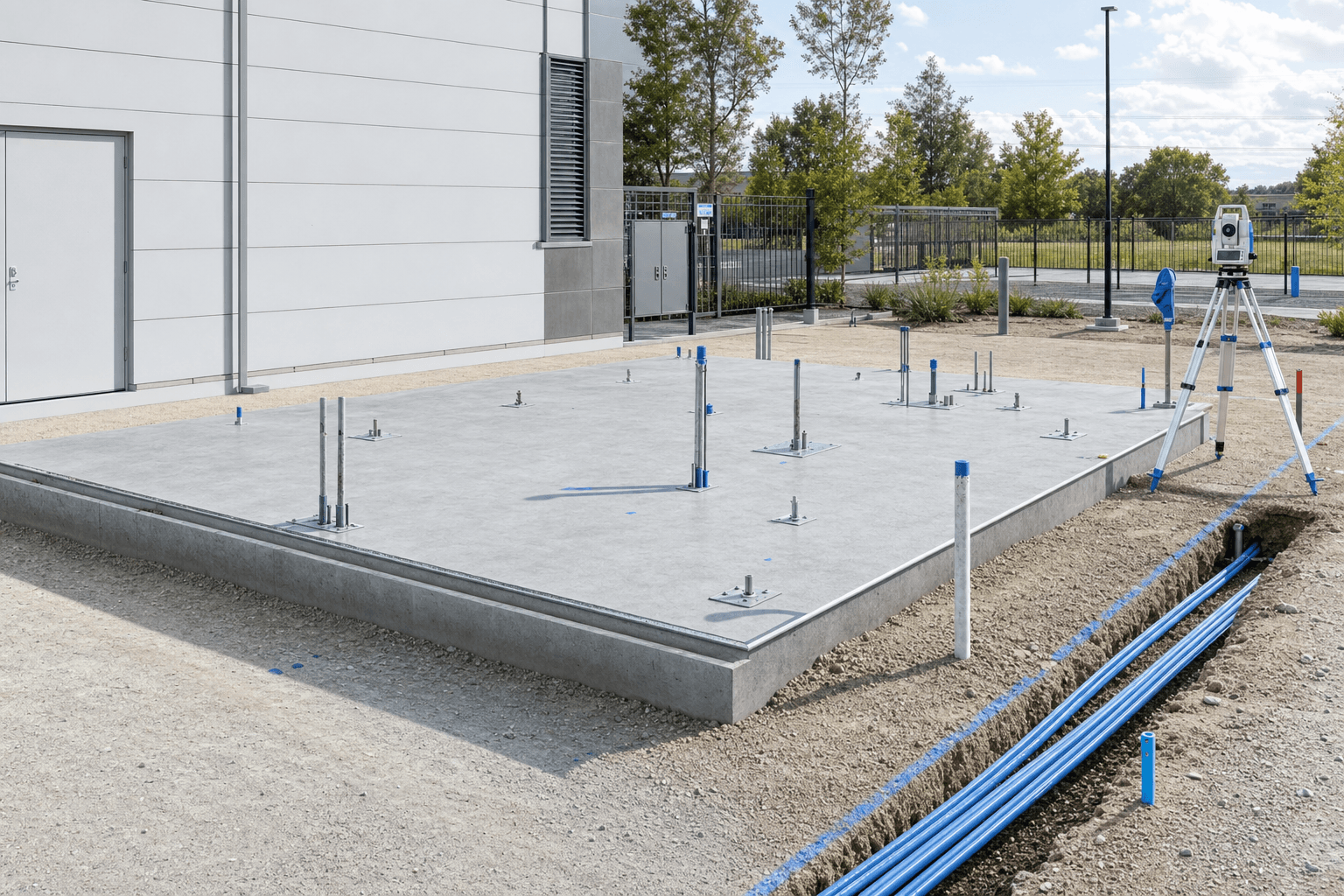
Confirm power, permits, ground, access, network. Exit criterion: power path and permit scope confirmed. Read the site & power readiness guide.
DEP-01Deployment
Deploying a factory-built modular AI data center is a six-stage process: site and power readiness, configuration, factory build and testing, transport and placement, commissioning, and operations. The stages overlap — the unit is built and tested in a factory while the site is prepared in parallel.
PUBLISHED LAST VERIFIED BY JOSEF ELIMELECHREVIEWED PODOS AI ENGINEERING
What the six stages actually decide
Site and power readiness and configuration come first, but factory build and site preparation run in parallel, and that overlap is what compresses the calendar.
Site power availability dominates the real calendar and sits outside any vendor's control. A site without a power path has an indeterminate timeline regardless of how fast the unit is built.
PODOS targets a 90-day window from order to commissioning for a standard unit — a design goal for a ready site, not a measured deployment statistic.
Capacity scales by repeating the same six stages for the next unit instead of re-entering a construction program.
Stage guides
This page is the overview. Each stage has its own guide covering what happens inside it, who owns it, and the criterion that has to be met before the next stage starts.
Confirm power, permits, ground, access, network. Exit criterion: power path and permit scope confirmed. Read the site & power readiness guide.
Fix the build specification from a bounded menu. Exit criterion: configuration freeze signed. Read the configuration guide.
Assembly, integration, burn-in on the line. Exit criterion: factory acceptance test passed. Read the factory build & testing guide.
Ship as heavy freight, rig, set, connect. Exit criterion: unit set and mechanically connected. Read the transport & placement guide.
Energize, verify, load-test on site power. Exit criterion: site acceptance test passed. Read the commissioning guide.
Monitor, maintain, grow unit by unit. Exit criterion: ongoing. Read the operations guide.
Stage index
Who owns each stage, and what has to be true before it closes.
| Code | Stage | What happens | Primary owner | Exit criterion |
|---|---|---|---|---|
| DP-01 | Site & power readiness | Confirm power, permits, ground, access, network | Owner / operator + utility | Power path and permit scope confirmed |
| DP-02 | Configuration | Fix the build specification from a bounded menu | Owner + PODOS | Configuration freeze signed |
| DP-03 | Factory build & testing | Assembly, integration, burn-in on the line | PODOS factory | Factory acceptance test passed |
| DP-04 | Transport & placement | Ship as heavy freight, rig, set, connect | Logistics + site crew | Unit set and mechanically connected |
| DP-05 | Commissioning | Energize, verify, load-test on site power | Commissioning team | Site acceptance test passed |
| DP-06 | Operations | Monitor, maintain, grow unit by unit | Operator | Ongoing |
DP-01 · DP-02
This page is the overview: what each stage covers, who owns it, what must be true before the next stage starts, and where the schedule risk actually lives. Each PODOS Pod is designed as a standardized 1-MW building block and designed for 128 GPUs, so the process repeats per unit rather than being re-engineered per project.
Everything starts with power. A modular unit removes construction from the critical path, but it cannot manufacture electrons: the site needs megawatt-class power available, or a credible path to it, before anything else matters. The IEA reports that data-centre electricity use surged in 2025 while grid-connection bottlenecks tightened[1], and Lawrence Berkeley National Laboratory estimates US data centers consumed 4.4% of US electricity in 2023, projected to reach 6.7–12% by 2028[2]. Competition for grid capacity is structural, not cyclical — which is why this stage comes first and owns the real calendar.
Readiness means answering a short list of questions honestly before an order is placed:
The full assessment, including the conditions that disqualify a site early, is in the site and power readiness guide.
Configuration fixes the build specification before the factory starts. Because the unit is standardized, this is a bounded menu rather than a design project: the GPU platform installed at integration, the electrical service arrangement at the site boundary, the heat-rejection option, the network handoff, and the operating model — who monitors and who maintains. The output is a configuration freeze: a signed specification the factory builds against and the reference every later acceptance test uses. What is deliberately not on the menu is the core architecture — enclosure, cooling loop, power distribution — which stays identical across units. The PODOS Pod page describes what is inside that fixed architecture, and the configuration engineering guide walks the menu decision by decision.
DP-03 · DP-04
The factory stage is where the modular model earns its schedule. Structure, power distribution, the closed-loop direct-to-chip liquid-cooling circuit, racks, and networking are assembled and integrated on a production line instead of being sequenced as separate trades on a construction site. Integration testing happens before shipment: point-to-point electrical verification, pressure and flow testing of the coolant loop, controls and safety interlocks exercised end to end, and burn-in of installed IT under load. The exit gate is a factory acceptance test against the configuration freeze — the factory build and testing guide covers the hold points and handover documents.
Factory testing has a real limit, and the commissioning stage exists to close it: it validates the unit against factory power and factory conditions — not against your utility, your grounding system, or your climate.
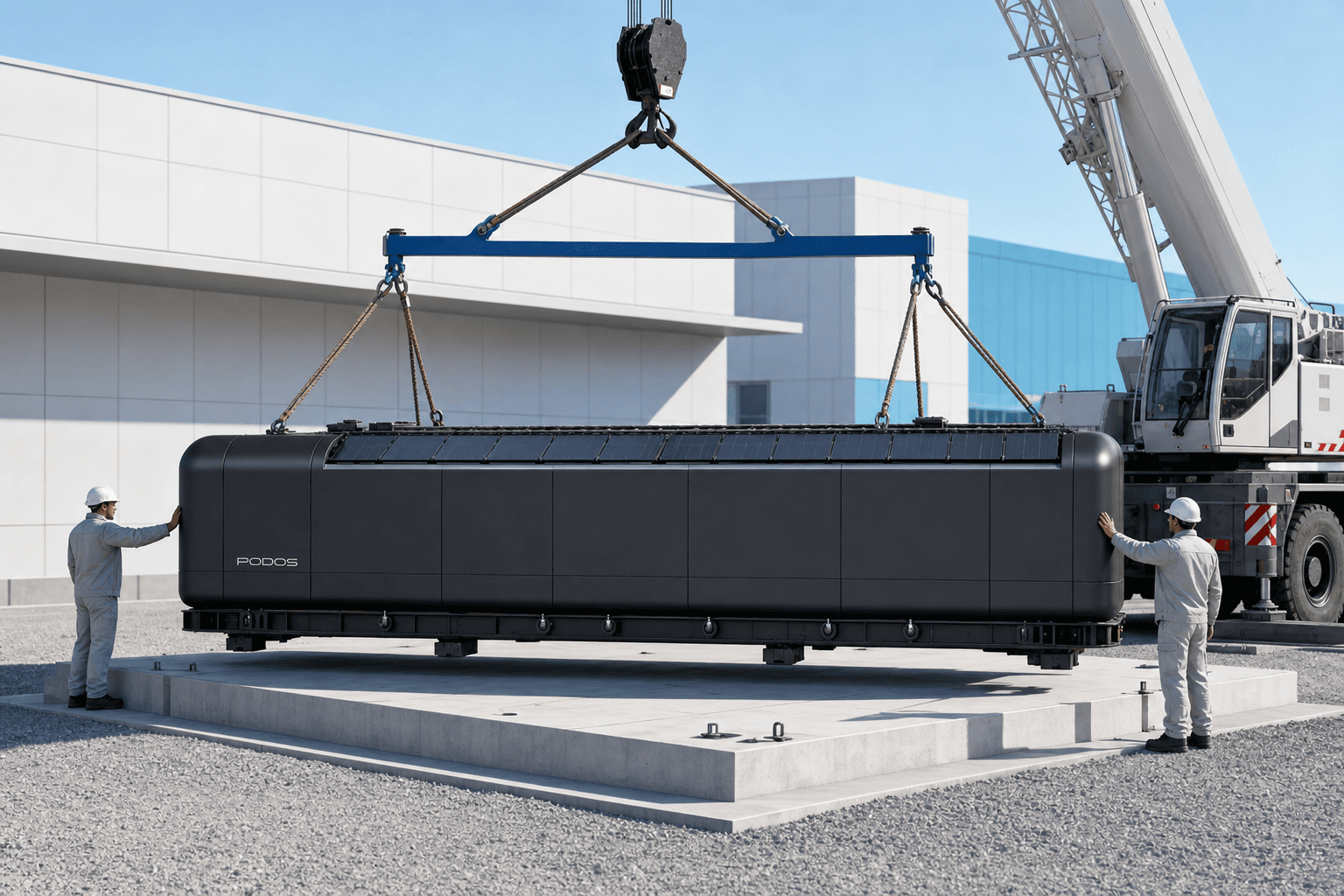
While the factory builds, the site is prepared: pad, conduit runs, service connections. This parallelism is the schedule mechanism — the two longest workstreams run at the same time instead of one after the other. The finished unit then ships as heavy road freight, is rigged onto the prepared surface, and is connected mechanically: power terminations, heat-rejection connections, network.
Placement is measured in days rather than months because nothing is being constructed on site — the unit arrives as a tested machine, and site work is limited to connections. The units are designed to be relocatable, so a later move follows the same steps in reverse. Route survey, freight envelope, permits, and the rigging sequence are detailed in the transport and placement guide.
DP-05 · DP-06
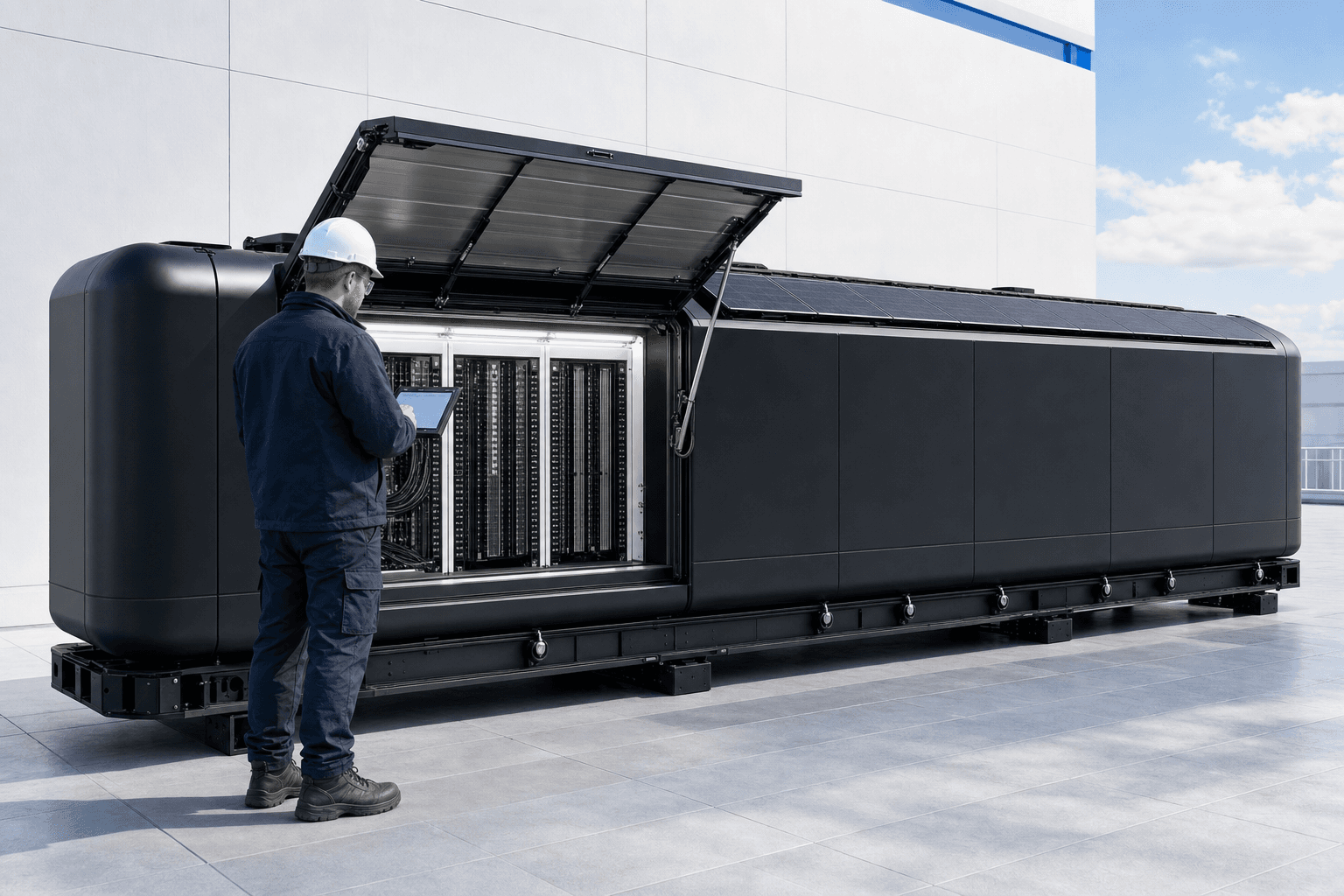
Commissioning proves the unit on real site power under real load. The sequence is conventional critical-facility practice applied to a factory-tested machine: staged energization with protection and grounding verification, cooling-loop verification against the thermal envelopes the IT equipment is specified for — ASHRAE’s thermal guidelines define the environmental classes commissioning verifies against[5]— then integrated load testing and deliberate failure-mode exercises (loss of a power path, loss of heat rejection) before workloads are admitted. Reliability analysis of the site’s electrical distribution follows established practice such as the IEEE 3006 series[6].
The discipline matters. In Uptime Institute’s 2025 global survey, roughly half of operators reported an outage with meaningful impact within the previous three years[7]. A factory-tested unit shortens commissioning; it does not replace it. The exit gate is a site acceptance test, after which the unit enters operations — the tests and sign-offs are enumerated in the commissioning guide.
Operations is the longest stage and the least discussed. It covers monitoring — power, thermals, coolant-loop health, IT telemetry — plus preventive maintenance on pumps, filtration, and heat-rejection equipment, a spares strategy, and physical security. Industry rack densities keep rising: Uptime Institute’s 2025 survey reports typical densities moving into the 10–30 kW band[7], which is why the liquid loop is maintained as a first-class system rather than an afterthought. The operations and maintenance guide covers service access, spares, and lifecycle planning.
Growth is additive. Because each unit is designed as a standardized 1-MW building block, capacity scales by repeating the same six stages for the next unit instead of re-entering a construction program. Which organizations this model fits is covered in the use-cases overview; how it differs from a conventional build is covered in the modular-vs-traditional comparison.
The target is arithmetic, not optimism: the factory stage and site preparation run concurrently, transport and placement are measured in days, and commissioning verifies a machine that has already passed a factory acceptance test.
90 days
Order to commissioning
Schedule
Three dependencies sit outside the target, and the largest of them is not a vendor decision.
PODOS targets a 90-day window from order to commissioning for a standard unit. The target is arithmetic, not optimism: the factory stage and site preparation run concurrently, transport and placement are measured in days, and commissioning verifies a machine that has already passed a factory acceptance test rather than debugging a first-of-a-kind assembly.
Three dependencies sit outside the target and can extend it: power availability at the site (the dominant variable), permitting timelines in the local jurisdiction, and transport distance and routing. The target is a design goal for a standard unit on a ready site — it is not a measured deployment statistic, and PODOS does not publish deployment counts or completed-project timelines at this stage.
HONEST LIMITS
QUESTIONS
PODOS targets a 90-day window from order to commissioning for a standard unit. The target assumes a ready site; in practice the calendar is set by site power availability, permitting, and transport, so the honest answer for a specific project starts with a site and power assessment.
Megawatt-class power available or contracted, applicable permits, a level load-rated surface, heavy-freight access to the placement point, and a network path. Power is the item to resolve first — it determines whether the rest of the schedule is real.
No. Site and power readiness and configuration come first, but factory build and site preparation run in parallel, and that overlap is what compresses the calendar. Commissioning and operations are sequential by nature — a unit is proven before it carries workloads.
Power availability, permitting, and access decide the calendar before a unit is ordered. Stage one is the assessment that tells you whether the rest of the schedule is real.