PLT-02·PODOS POD
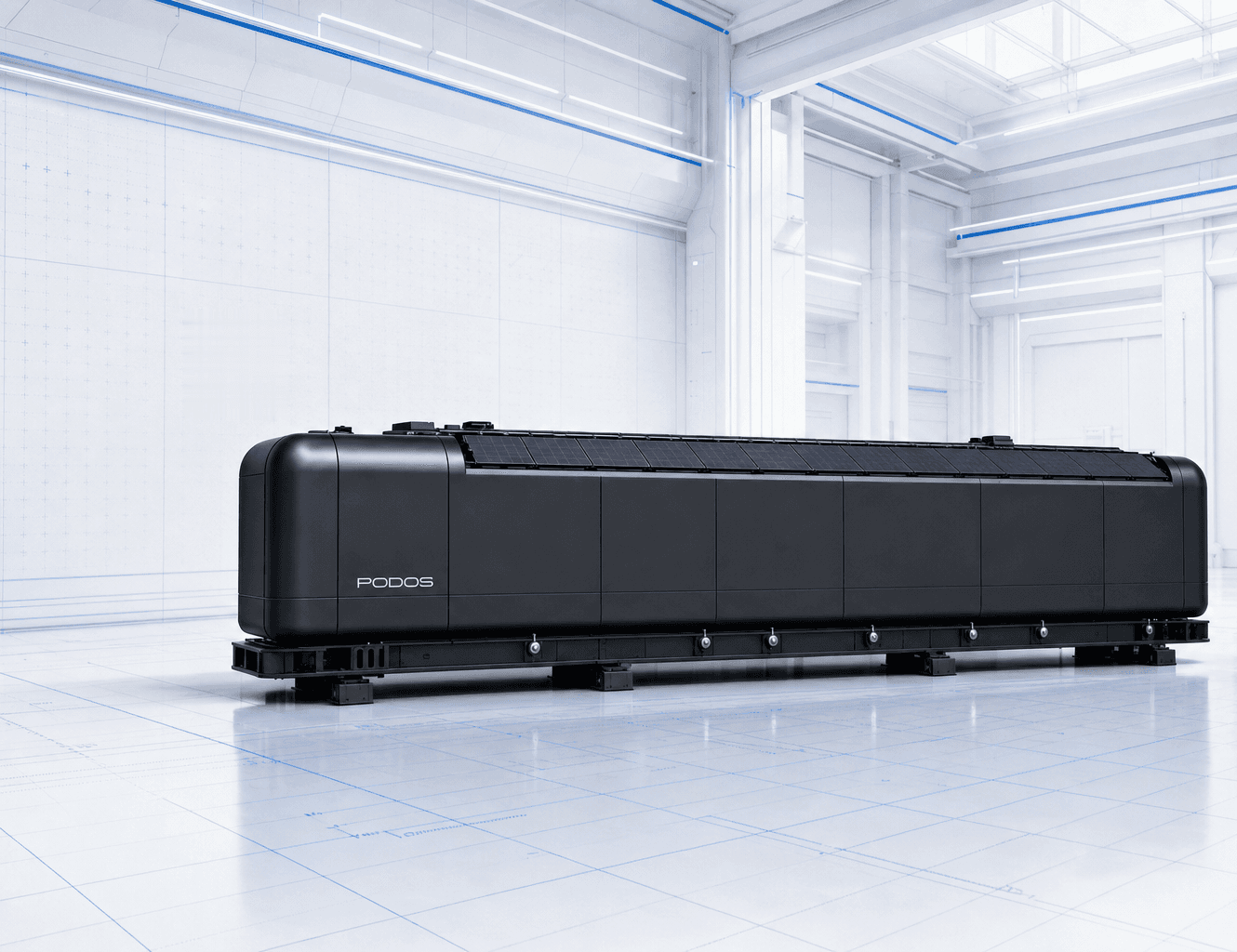
PODOS Pod: designed as a standardized 1 MW building block for AI compute
The PODOS Pod is a factory-built modular data-center unit: power distribution, direct-to-chip liquid cooling, GPU racks, and networking integrated in one transportable enclosure. It is assembled and tested in a factory, shipped complete, and commissioned on a prepared site — each unit is designed for 128 GPUs.
PUBLISHED LAST VERIFIED BY JOSEF ELIMELECHREVIEWED PODOS AI ENGINEERING
1 MW
Designed unit capacity
Each PODOS Pod is designed as a standardized 1 MW building block for AI infrastructure.
128 GPUs
Designed for, per unit
Each PODOS Pod is designed for 128 GPUs.
90 days
Deployment target
PODOS targets a 90-day window from order to commissioning for a standard unit.
DESIGN TARGETS FROM THE PODOS CLAIMS REGISTER — NOT MEASURED DEPLOYMENT DATA
What the PODOS Pod is
A PODOS Pod is a product, not a project. Conventional AI data-center capacity is delivered as construction: a site is selected, a shell is erected, and the electrical and cooling plants are engineered in the field for that one building. The pod inverts the sequence. The unit is designed to be manufactured on a production line, integrated and tested before it leaves the factory, and placed on a prepared site. Capacity then grows by repetition — adding units — rather than by redesign. How that differs from a conventional build, step by step, is covered in modular vs traditional AI data centers.
The pod is the hardware half of the PODOS platform. The software half, Syntropic, addresses how efficiently the GPUs inside are used. The platform overview explains how the two layers fit together.
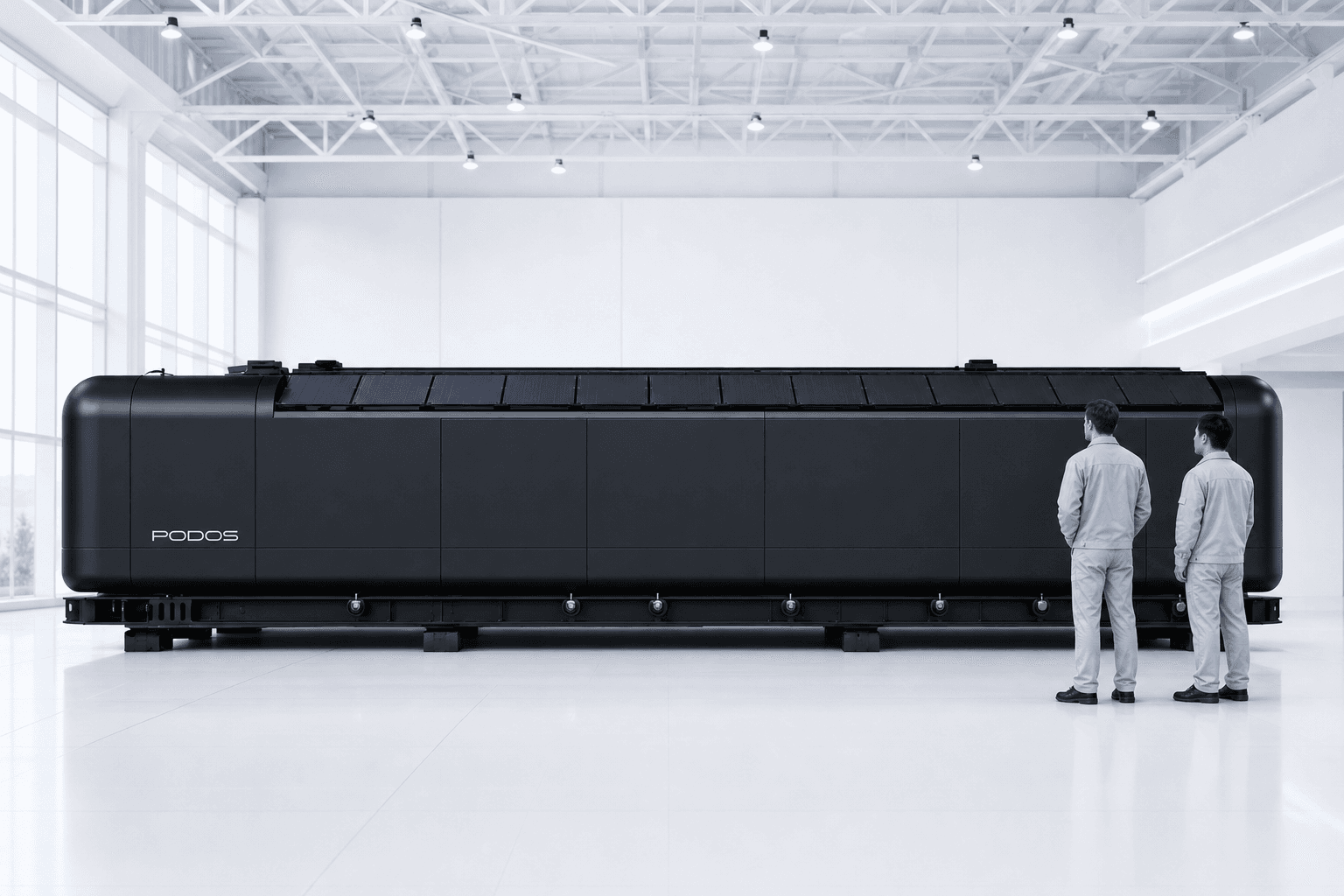
What is designed into a 1 MW unit
Six subsystems that a conventional build procures, engineers, and commissions separately arrive in the pod as one integrated machine.
| Code | Subsystem | Role | Design approach |
|---|---|---|---|
| PP-01 | Compute bay | Houses the GPU cluster | Liquid-cooled racks, designed for 128 GPUs per unit, pre-cabled as one cluster |
| PP-02 | Power distribution | Utility input to rack busways | Medium-voltage utility input stepped down and distributed inside the enclosure; the electrical chain is installed and factory-tested, not field-assembled |
| PP-03 | Cooling | Removes heat at the chip | Closed-loop direct-to-chip liquid cooling — cold plates on the highest-power silicon, no evaporative water consumption in the design |
| PP-04 | Enclosure | Thermal, weather, and access envelope | Purpose-designed insulated enclosure engineered as a data-center envelope, not a converted freight container |
| PP-05 | Networking | Cluster fabric and uplink | Rack-to-rack fabric terminated inside the unit; external connectivity lands at the enclosure boundary |
| PP-06 | Controls | Monitoring and protection | Integrated power, thermal, and coolant-loop telemetry, designed to be exercised during factory burn-in |
Subsystem descriptions reflect the current design specification. PODOS has not published measured performance data for these subsystems.
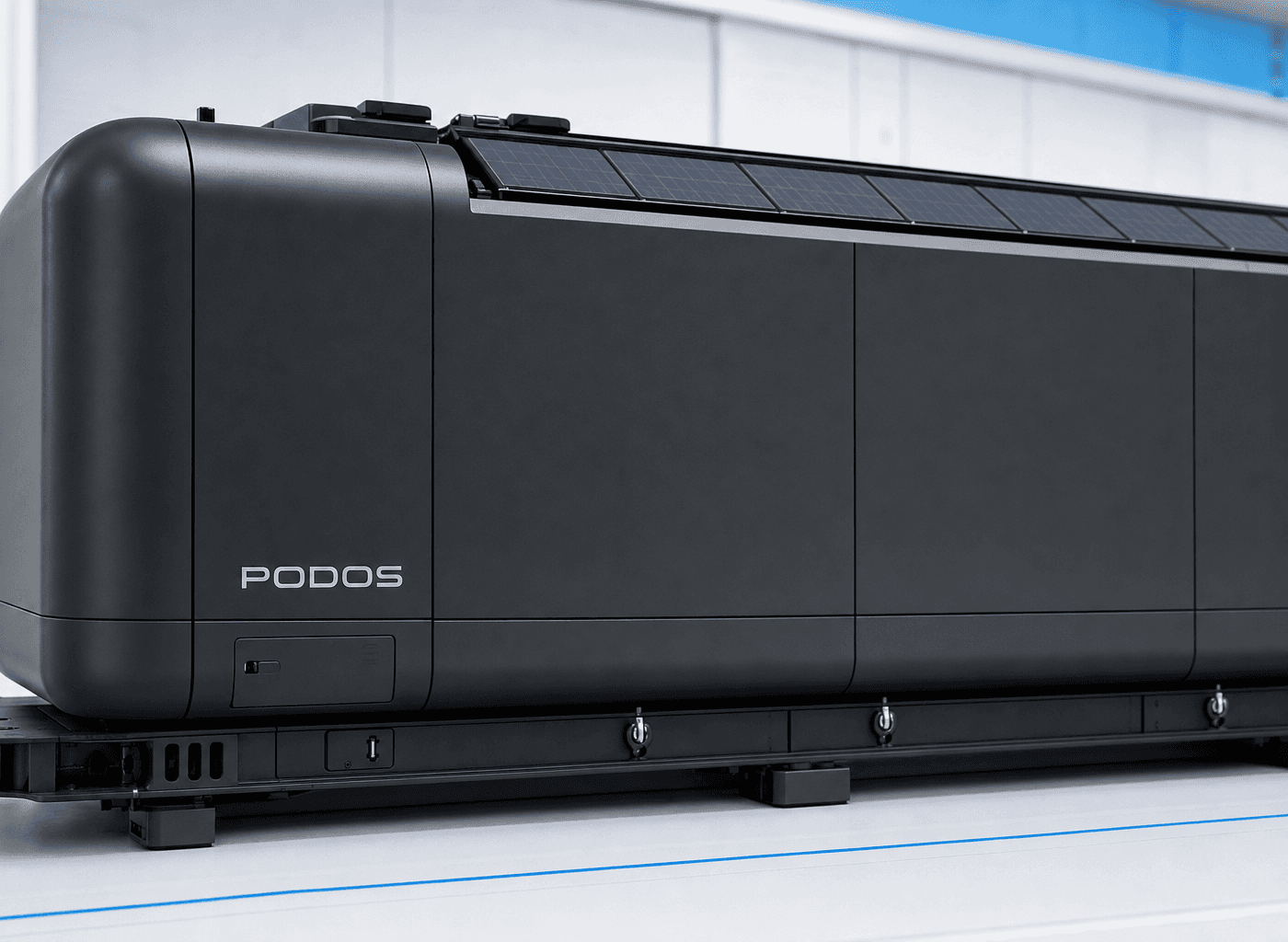
The cooling and electrical subsystems carry most of the engineering weight; they are documented in depth in direct-to-chip liquid cooling and data-center power architecture.
Why 1 MW is the designed unit size
AI hardware has collapsed the megawatt into a few racks. NVIDIA's GB200 NVL72 packs 72 GPUs and 36 CPUs into a single liquid-cooled rack acting as one NVLink domain[4], and the Uptime Institute's 2025 operator survey shows rack densities climbing into the 10–30 kW band industry-wide, with AI racks far beyond it[3]. At those densities a megawatt is no longer a hall — it is a short row of racks. That is why the pod is designed at 1 MW: the smallest envelope that still holds a coherent GPU cluster, and the largest one that can be built, transported, and craned onto a site as a single factory-made object.
The grid pushes toward the same number from the other side. The IEA projects data centres rising from about 1.5% of global electricity demand in 2025 to roughly 3% — around 945 TWh — by 2030[1], and Lawrence Berkeley National Laboratory estimates US data centres alone could reach 6.7–12% of national electricity consumption by 2028, up from 4.4% in 2023[2]. Campus-scale interconnections queue for years against that demand. A load in the pod's designed 1 MW class, by contrast, fits the distribution infrastructure that already exists at many industrial and commercial sites. The unit is designed to put compute where power is already available instead of waiting for new power to reach the compute.
Factory build and the 90-day target
PODOS targets a 90-day window from order to commissioning for a standard unit. The target rests on one structural change: the slowest work moves off the critical path. While the unit is assembled, integrated, and burned in at the factory, the site is prepared in parallel — pad, utility connection, network. Field work reduces to placement, hook-up, and acceptance testing. The 90-day figure is a PODOS target, not a measured average of completed deployments.
What factory integration and site preparation each involve, stage by stage, is laid out on the deployment page.
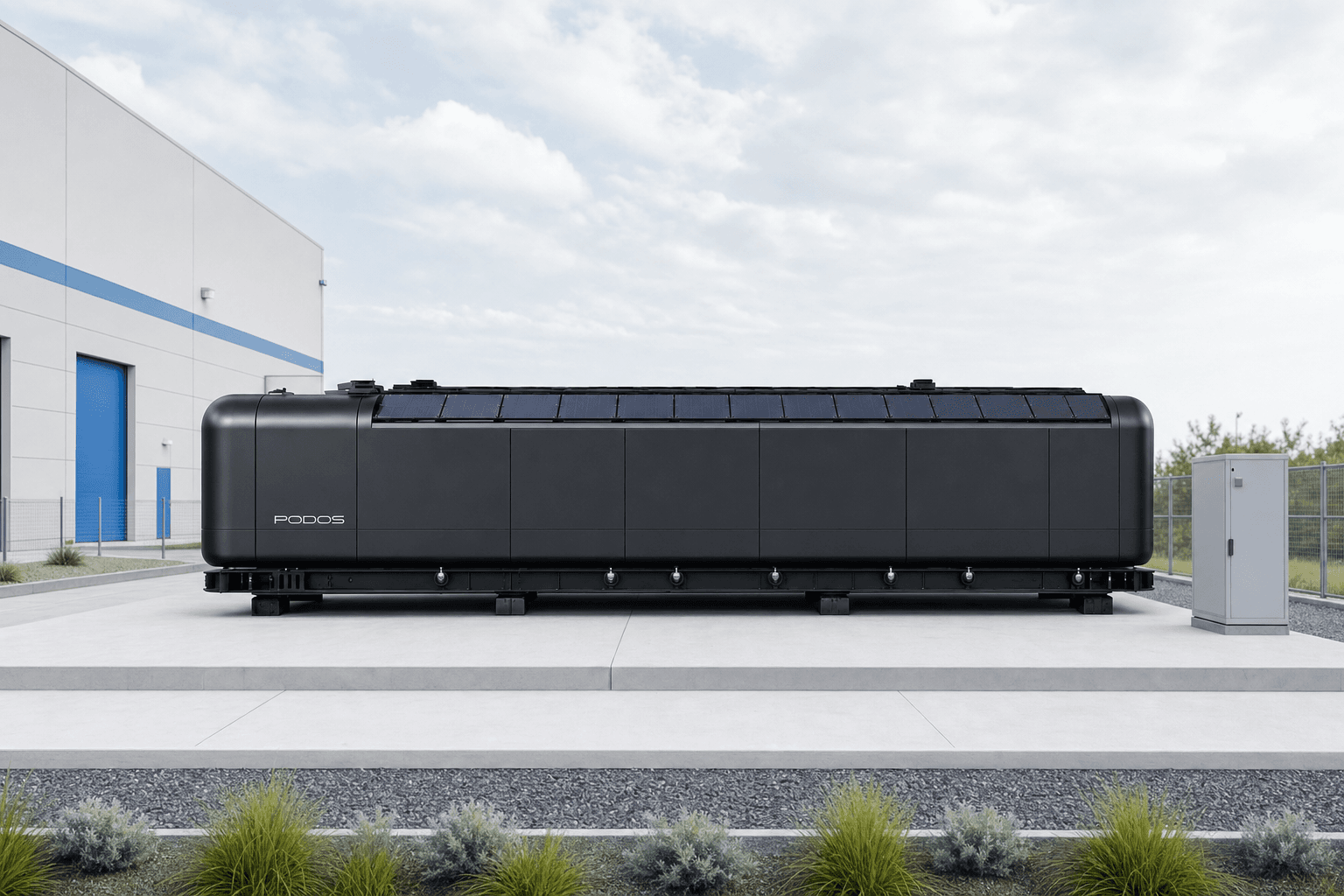
Does the 1 MW unit design fit your problem?
A short diagnostic. The pod is a specific answer to a specific shape of problem — it is the wrong answer to others.
Signals a pod fits
- You need dedicated AI capacity in megawatt-scale increments — not tens of megawatts on day one.
- Power is available or procurable at your site: behind an existing meter, at an industrial facility, or from on-site generation.
- Data residency, security, or latency argues for compute on ground you control — the pattern behind most PODOS use cases.
- Your timeline is measured in quarters, not years.
- You expect to scale by adding units, not by re-architecting a facility.
Signals it does not
- You are planning a single campus of hundreds of megawatts with its own substation — purpose-built construction amortizes better at that scale.
- Your workloads are occasional or bursty — cloud capacity will price better than owned hardware.
- There is no realistic path to roughly a megawatt of power at your site.
- Your procurement requires audited, measured facility data today — PODOS figures are currently design targets.
Limitations and open questions
- Every PODOS number on this page is a design target. There are no completed customer deployments to cite, and product imagery elsewhere on this site depicts design intent, not installed units.
- The 1 MW design granularity carries overhead at very large scale: each unit duplicates enclosure, controls, and cooling plant that a monolithic facility would share.
- The unit does not remove site obligations. Power procurement, permitting, a structural pad, and network connectivity remain the buyer's critical path, and their timelines vary by jurisdiction.
- Direct-to-chip liquid cooling demands operational discipline — coolant quality, loop maintenance, serviceability procedures. Industry standardization of these interfaces is still in progress through bodies like the Open Compute Project[6], and ASHRAE guidance on liquid-cooled facilities continues to evolve[5].
- GPU pricing, allocation, and lead times sit outside the unit specification and can dominate a real project schedule.
Frequently asked questions
Is the PODOS Pod a shipping-container data center?
No. The PODOS Pod is a purpose-designed, factory-built data-center unit. It shares the logistics logic of containerized systems — build centrally, ship complete — but the enclosure is engineered from the start as a data-center envelope, with thermal insulation, cooling integration, and service access designed in, rather than adapted from an ISO freight container.
How many GPUs does one PODOS Pod hold?
Each PODOS Pod is designed for 128 GPUs, housed in liquid-cooled racks inside the unit. This is a design specification, not a measured deployment figure.
How long does a PODOS Pod take to deploy?
PODOS targets a 90-day window from order to commissioning for a standard unit, with factory assembly and site preparation running in parallel. The 90-day figure is a PODOS target, not a measured average of completed deployments.
Can PODOS Pods be combined into larger installations?
Each unit is designed as a standardized 1 MW building block, and larger capacity is designed to be reached by placing multiple units on one site rather than by redesigning the unit. PODOS has not completed multi-unit deployments; scaling descriptions are design intent.
Sources
- [1] Energy and AI — Executive Summary — IEA, Apr 2025
- [2] 2024 United States Data Center Energy Usage Report (LBNL-2001637) — Lawrence Berkeley National Laboratory, Dec 2024
- [3] Global Data Center Survey 2025 — Uptime Institute, Jul 2025
- [4] GB200 NVL72 product page — NVIDIA, accessed Aug 2026
- [5] Emergence and Expansion of Liquid Cooling in Mainstream Data Centers (white paper) — ASHRAE TC 9.9, c. 2021
- [6] ACS Liquid Cooling Cold Plate Requirements, Rev 1.0 — Open Compute Project