Hyperscale campuses
At hundreds of megawatts on one site, a purpose-built campus amortizes design, sitework, and utility infrastructure across the whole build. Unit-by-unit delivery adds little there.
CMP-01Compare
A modular AI data center is assembled from factory-built units — power, cooling, and IT integrated and tested before they reach the site. A traditional data center is engineered and constructed in place, trade by trade.
PUBLISHED LAST VERIFIED BY JOSEF ELIMELECHREVIEWED PODOS AI ENGINEERING
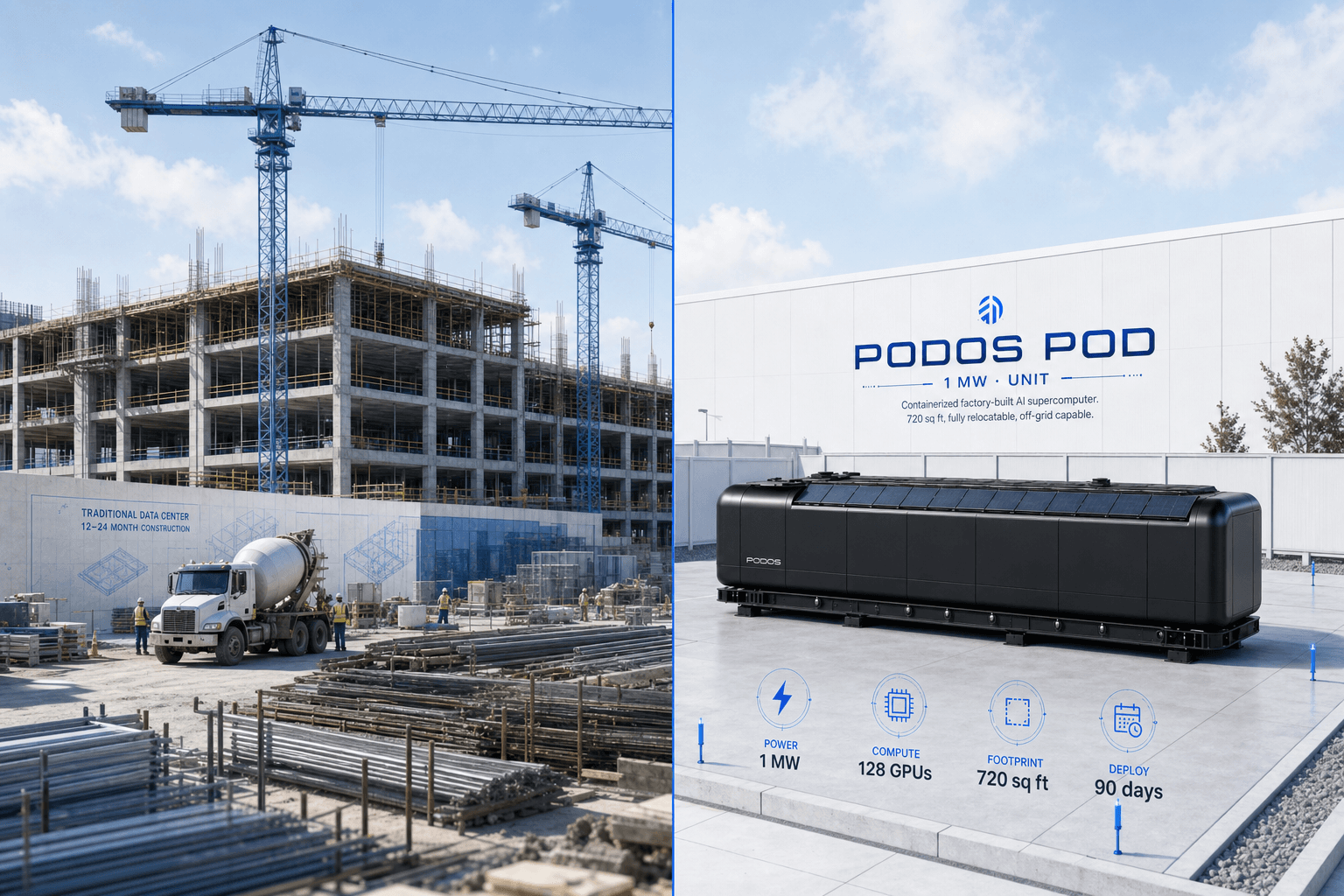
Left: built in place. Right: factory-built, commissioned on a pad.
The honest verdict
CMP-02Context
AI demand turned a niche procurement question into a schedule question. The IEA projects data centres rising from around 1.5% of global electricity consumption in 2025 to roughly 3% — about 945 TWh — by 2030[1]; Lawrence Berkeley National Laboratory estimates US data centers used 4.4% of US electricity in 2023, projected at 6.7–12% by 2028[2]; and grid-connection bottlenecks tightened through 2025 even as demand surged[4].
The workload changed shape too. Uptime Institute's 2025 survey reports typical rack densities rising into the 10–30 kW band, with AI clusters beyond it[3], and ASHRAE documents liquid cooling displacing air as densities climb[5]. Dense capacity rewards tight integration of direct-to-chip liquid cooling and power architecture — work a factory repeats and a field crew rebuilds on every project. That is the engineering case for modular. It is not the whole case.
The comparison
Each row states where the risk or constraint actually sits — read it against your project, not a vendor's brochure, including ours.
| Criterion | Traditional (built in place) | Modular (factory-built) |
|---|---|---|
| Schedule | Sequential: design, permits, sitework, shell, fit-out, commissioning — each trade waits on the last. Often dominated by permitting and interconnection. | Parallel: factory production runs while sitework and permitting proceed; on-site scope shrinks to foundations, tie-ins, and commissioning. |
| Capital profile | Large up-front commitment sized to forecast demand; capacity arrives in one tranche, often before it is fully utilized. | Capacity bought in unit-sized increments, so spend tracks demand — but per-unit procurement carries a manufacturer's margin. |
| Siting | Wide freedom: any parcel that can be permitted and powered; the building is designed to the site. | Constrained by logistics: unit dimensions and weights must survive road transport and crane placement. |
| Scalability | Expansion is another construction project; scale economics favor very large single campuses. | Expansion is repetition: add units as demand and available power allow — closer to procurement than construction. |
| Quality control | Field labor quality varies by market; integration issues tend to surface during on-site commissioning. | Repeatable assembly and pre-shipment testing catch integration issues early; the factory line becomes the concentrated point of process risk. |
| Customization limits | Nearly unlimited: floor plans, security zoning, redundancy topology, and architecture are bespoke. | Bounded by the product: configuration lives inside the unit's designed envelope; needs outside it push back toward a custom build. |
| Permitting | Full building-construction path: zoning, structural, fire, and environmental review for a permanent structure. | Sometimes shorter where jurisdictions treat units as pre-engineered equipment on a foundation — treatment varies by authority and is never guaranteed. |
Case A
Four project shapes where constructing in place remains the correct decision.
At hundreds of megawatts on one site, a purpose-built campus amortizes design, sitework, and utility infrastructure across the whole build. Unit-by-unit delivery adds little there.
Custom security zoning, unusual redundancy topologies, special floor loading, or multi-tenant architecture exceed any standardized unit's envelope. Bespoke problems justify bespoke buildings.
A powered building with usable structure already in hand can make a fit-out cheaper and faster than shipping new enclosures — the enclosure is the part you already own.
Where the authority routes factory-built units through the full building-permit path anyway, the permitting advantage shrinks and the decision reverts to logistics and quality control.
Case B
The same count, on the same terms: four project shapes where factory delivery is the correct decision.
When GPU capacity has a deadline, moving integration work off the critical path and into a factory is the main lever a buyer controls. Sitework and production run in parallel instead of in sequence.
Liquid-cooled AI racks exceed the design assumptions of most legacy floor plans[3][5]. A unit engineered around direct-to-chip cooling avoids retrofitting a building that was designed for air.
With grid connections bottlenecked[4], compact factory-built units can be placed at sites that already have power — substations, industrial parcels, campus edges — rather than waiting on a greenfield interconnection.
Buying capacity in unit-sized increments converts a forecast-sized capital commitment into a sequence of smaller, reversible decisions. Under-forecasting costs a purchase order, not a building.
Vendors publish targets; operators rarely publish actuals.
10–30 kW
Typical rack density band — Uptime Institute, 2025
Ground rules
Change any one of these and the rows above change with it.
New-build capacity for AI or other high-density workloads, where both delivery models are actually available.
Power availability binds both paths equally; neither model manufactures megawatts.
No cost figures. Delivered $/MW varies too widely by site, scale, and scope to publish a general number honestly.
"Modular" is used vendor-neutrally for factory-built units of any form factor — see the AI infrastructure glossary for term boundaries.
Honest limits
Disclosure
PODOS builds on the modular side of this table. Each PODOS Pod is designed as a standardized 1-MW building block for AI infrastructure, designed for 128 GPUs, and PODOS targets a 90-day window from order to commissioning for a standard unit — a target, not a measured deployment figure. The platform overview explains the architecture, the PODOS Pod page carries the unit specification, and the deployment model covers what happens between order and commissioning. If your project matches the traditional-wins rows above, a pod is the wrong tool.
QUESTIONS
A facility assembled from factory-built modules that integrate power distribution, cooling, and IT space, tested before delivery and completed on site with foundations, utility tie-ins, and commissioning. A traditional data center is constructed trade by trade in place.
No. Container data centers are one subset of the modular category. Many current modular units are purpose-engineered enclosures rather than converted shipping containers, though both share the factory-built, ship-then-commission delivery model.
There is no defensible general answer. Delivered cost depends on site conditions, scale, labor market, power path, and what scope each quote includes. Category-wide cost claims usually compare unlike scopes; compare fully delivered scope for your specific site instead.
AI racks concentrate more power and heat than most existing facilities were designed around — Uptime Institute's 2025 survey reports typical rack densities rising into the 10 to 30 kW band, with AI clusters above it — and dense racks increasingly require liquid cooling. Factory integration of power, liquid cooling, and IT in one tested unit is a direct response to that shift.
Bring the parcel, the power path, and the density target. If the traditional-wins rows describe your project, engineering will say so.