01Platform

The modular AI data center, delivered as one platform

A modular AI data center is AI compute capacity built as a standardized, factory-integrated unit — power distribution, liquid cooling, racks, and networking assembled and tested before the unit ships — rather than as a custom construction project. PODOS approaches the category as a single platform with two layers: the PODOS Pod, a factory-built hardware unit designed as a standardized 1 MW building block, and Syntropic, the compression software layer designed to raise how efficiently that hardware serves AI workloads.

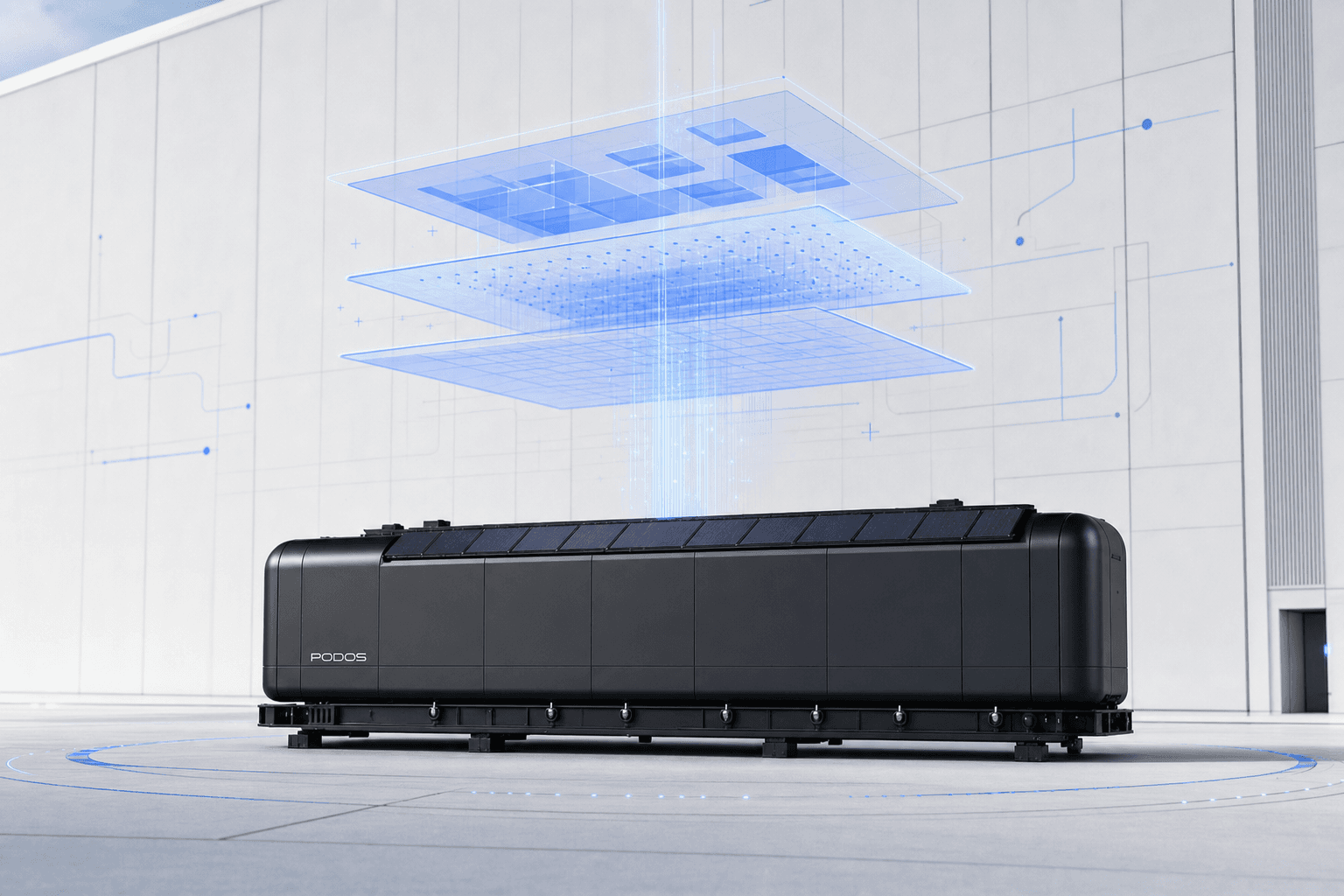
PODOS Pod beneath an abstract translucent software layer, representing the integrated platformCONCEPTUAL VISUALIZATION
The two layers: the factory-built Pod, and the software layer above it

PUBLISHED LAST VERIFIED BY JOSEF ELIMELECHREVIEWED PODOS AI ENGINEERING

02Context

Why AI infrastructure is becoming a product

Demand is outrunning the way facilities get built. The IEA projects data-centre electricity consumption will roughly double from about 1.5 percent of global electricity today to around 945 TWh — about 3 percent — by 2030 (2025 estimate)[1]. In the United States, Lawrence Berkeley National Laboratory measured data centers at 4.4 percent of national electricity in 2023 and projects 6.7 to 12 percent by 2028[2]. The binding constraint has moved from chips to sites and grid connections: the IEA reported in 2025 that connection bottlenecks tightened even as data-centre electricity use surged[3].

At the same time, the unit of compute is densifying. The Uptime Institute’s 2025 operator survey shows rack densities climbing into the 10–30 kW band[4], and rack-scale systems such as NVIDIA’s GB200 NVL72 place 72 GPUs in a single liquid-cooled rack[5]. ASHRAE’s technical committee has documented why air cooling gives way to liquid at these densities[6]. Buildings designed around air handling absorb this shift slowly and expensively.

The modular response treats the facility itself as a manufactured product: standardize one unit, integrate and test it in a factory, and repeat it, instead of engineering each building as a bespoke project. The trade-offs against conventional construction are examined in detail in the modular versus traditional data center comparison.
03Architecture

Two layers, one system

The platform splits into a physical layer and a software layer. Each is documented on its own page; the summaries below are the map.

PL-01Hardware layer

PODOS Pod — the physical layer

The PODOS Pod is a factory-built unit designed as a standardized 1 MW building block and designed for 128 GPUs, with closed-loop direct-to-chip liquid cooling and medium-voltage power input integrated at manufacture. Because integration, testing, and burn-in happen in the factory rather than on site, PODOS targets a 90-day window from order to commissioning for a standard unit — a target, not a measured deployment record.

Start with the PODOS Pod unit architecture, then go deeper on the direct-to-chip liquid cooling loop and the power architecture from grid input to rack.

PL-02Software layer

Syntropic — the software layer

Syntropic is compression software for AI workloads, designed to reduce the memory footprint of serving models so that a fixed hardware envelope does more useful work. The division of labor is deliberate: hardware determines how much compute a site can host; software determines how much of that compute turns into throughput. PODOS has not published performance benchmarks for Syntropic — its capabilities are described as design intent.

The Syntropic software layer page covers the design approach and its current status.

The reason one company builds both layers is the interface between them. Serving efficiency is usually lost where facility design and software stacks meet — cooling designed without knowledge of the workload, software tuned without knowledge of the power and thermal envelope. Industry standardization of liquid-cooling interfaces through the Open Compute Project makes factory integration practical with multi-vendor parts[7]; designing both sides of the remaining interface together is the platform argument.

04Platform map

The platform, mapped

Every subsystem below carries an honest design status. Nothing on this page describes an operating facility.

SubsystemWhat it doesDesign statusDocumentation
COMPUTEHosts the GPU racks; each unit is designed for 128 GPUs.Design targetPODOS Pod architecture
COOLINGClosed-loop direct-to-chip liquid cooling; no evaporative water consumption by design.Designed, pre-deploymentDirect-to-chip cooling
POWERMedium-voltage input with factory-integrated distribution to the racks.Designed, pre-deploymentPower architecture
DEPLOYFactory integration, testing, and burn-in; a targeted 90-day window from order to commissioning.Company targetDeployment process
SOFTWARECompression layer designed to raise serving efficiency on the installed hardware.Design intent; no published benchmarksSyntropic
SCALECapacity added in repeatable increments — each unit designed as a standardized 1 MW building block.Design modelUse cases
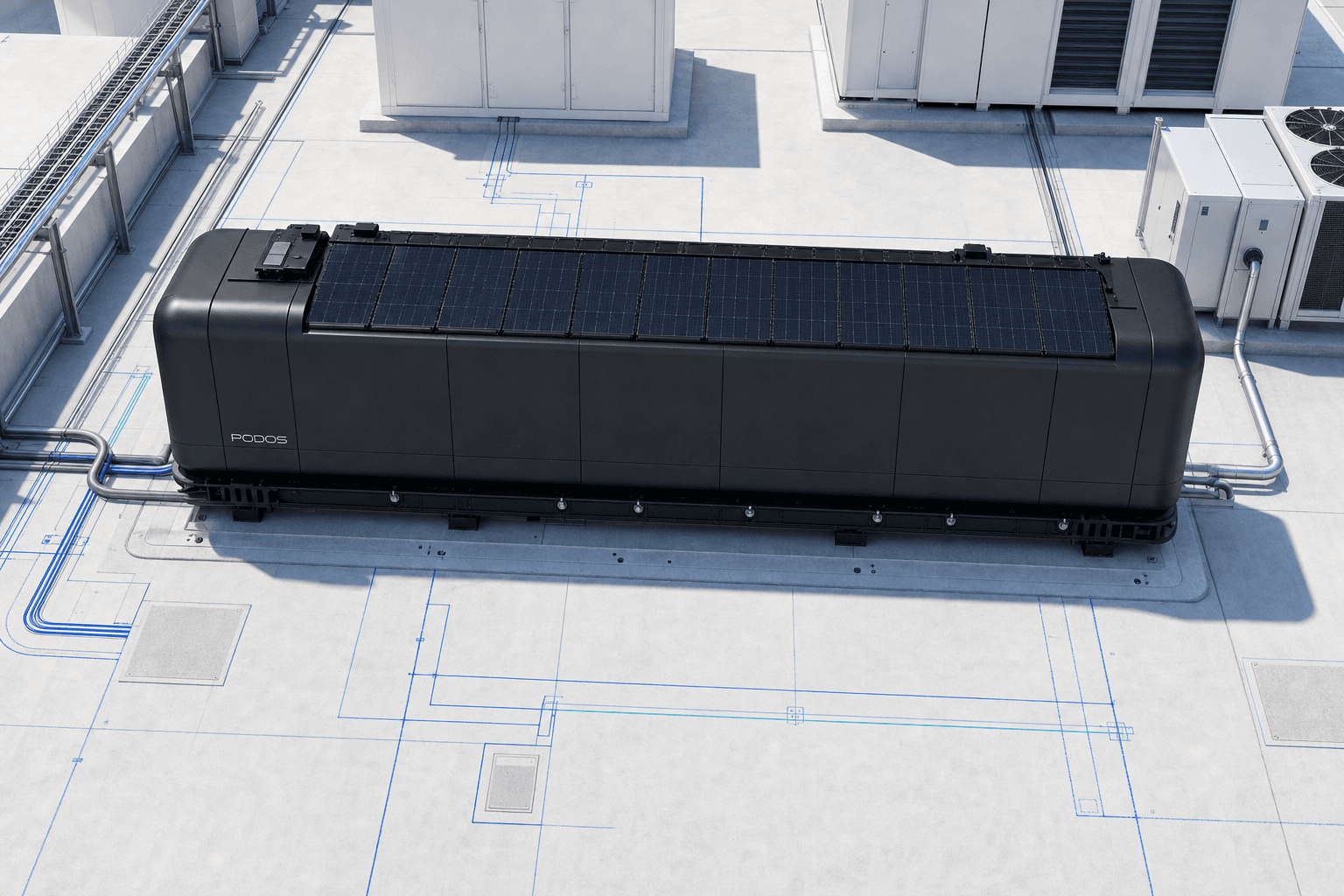
Overhead view of a PODOS Pod on a marked technical pad showing power, fiber, and cooling interfacesCONCEPTUAL VISUALIZATION
Site interfaces on a unit pad: power feed, fiber route, cooling connection
05Limits

Limitations, stated plainly

06Index

Where to go next

07FAQ

Frequently asked questions

What is a modular AI data center?

A modular AI data center is AI compute capacity built as standardized, factory-integrated units rather than as a one-off construction project. Power distribution, liquid cooling, racks, and networking are assembled and tested before each unit ships to site.

Is a modular data center the same as a containerized data center?

They overlap but are not the same. Containerized usually describes a form factor — ISO shipping-container enclosures. Modular describes a manufacturing model — standardized units integrated in a factory, whatever the enclosure. A modular unit can use a container envelope, but it does not have to.

How fast is a PODOS Pod designed to deploy?

PODOS targets a 90-day window from order to commissioning for a standard unit. That figure is a company target, not a measured deployment record.

Does PODOS operate deployed data centers today?

No. PODOS is at the design and pre-deployment stage. The specifications published on this site describe design targets, not operating facilities.

Sources

  1. [1] Energy and AI — Executive SummaryIEA, Apr 2025
  2. [2] 2024 United States Data Center Energy Usage Report (LBNL-2001637)Lawrence Berkeley National Laboratory, Dec 2024
  3. [3] Data centre electricity use surged in 2025, even with tightening bottlenecks driving a scramble for solutionsIEA, 2025
  4. [4] Global Data Center Survey 2025Uptime Institute, Jul 2025
  5. [5] GB200 NVL72 product specificationsNVIDIA, 2025
  6. [6] Emergence and Expansion of Liquid Cooling in Mainstream Data Centers (white paper)ASHRAE TC 9.9, c. 2021
  7. [7] Cooling Environments ProjectOpen Compute Project, ongoing