Enterprise AI
Workload fit, buyer roles, site constraints, power, cooling, and network for enterprises deciding between cloud GPUs and dedicated on-site AI capacity.Enterprise AI infrastructure: when on-site GPUs make sense →
UC-01Use cases
Modular AI infrastructure fits organizations that need dedicated GPU capacity on their own terms — their site, their power, their data — and cannot wait years for a conventional facility. It fits poorly where demand is small or intermittent, where no realistic power path exists, or where an existing data center still has headroom.
The pattern behind every profile
Sustained fine-tuning and steady inference behave differently from bursty experimentation, and only one of them justifies owned capacity.
Power, cooling, space, data governance, or time. The binding one decides whether hardware selection is even the right next step.
Whether a factory-built unit relieves that constraint — or merely relocates it somewhere the problem is still yours.
Framing
Demand for dedicated AI capacity is broad-based, not a hyperscaler phenomenon. U.S. data centers consumed about 4.4% of national electricity in 2023, with Lawrence Berkeley National Laboratory projecting 6.7–12% by 2028[1], and the IEA expects global data-centre electricity use to roughly double toward ~945 TWh by 2030, driven largely by AI[2]. Yet the facilities most organizations already operate were not built for this: the Uptime Institute's 2025 operator survey places typical rack densities in the 10–30 kW band, well below what dense GPU nodes draw [3].
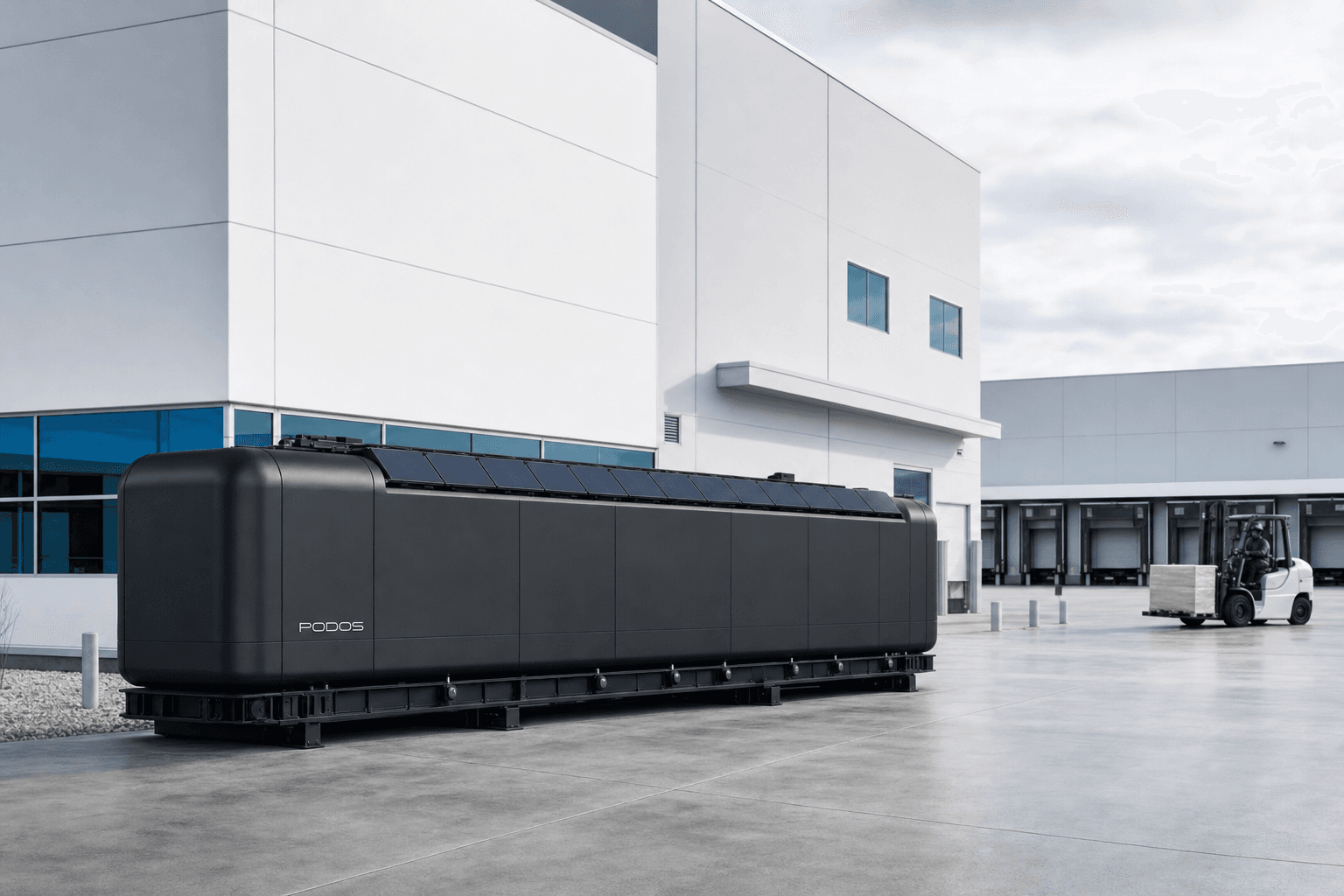
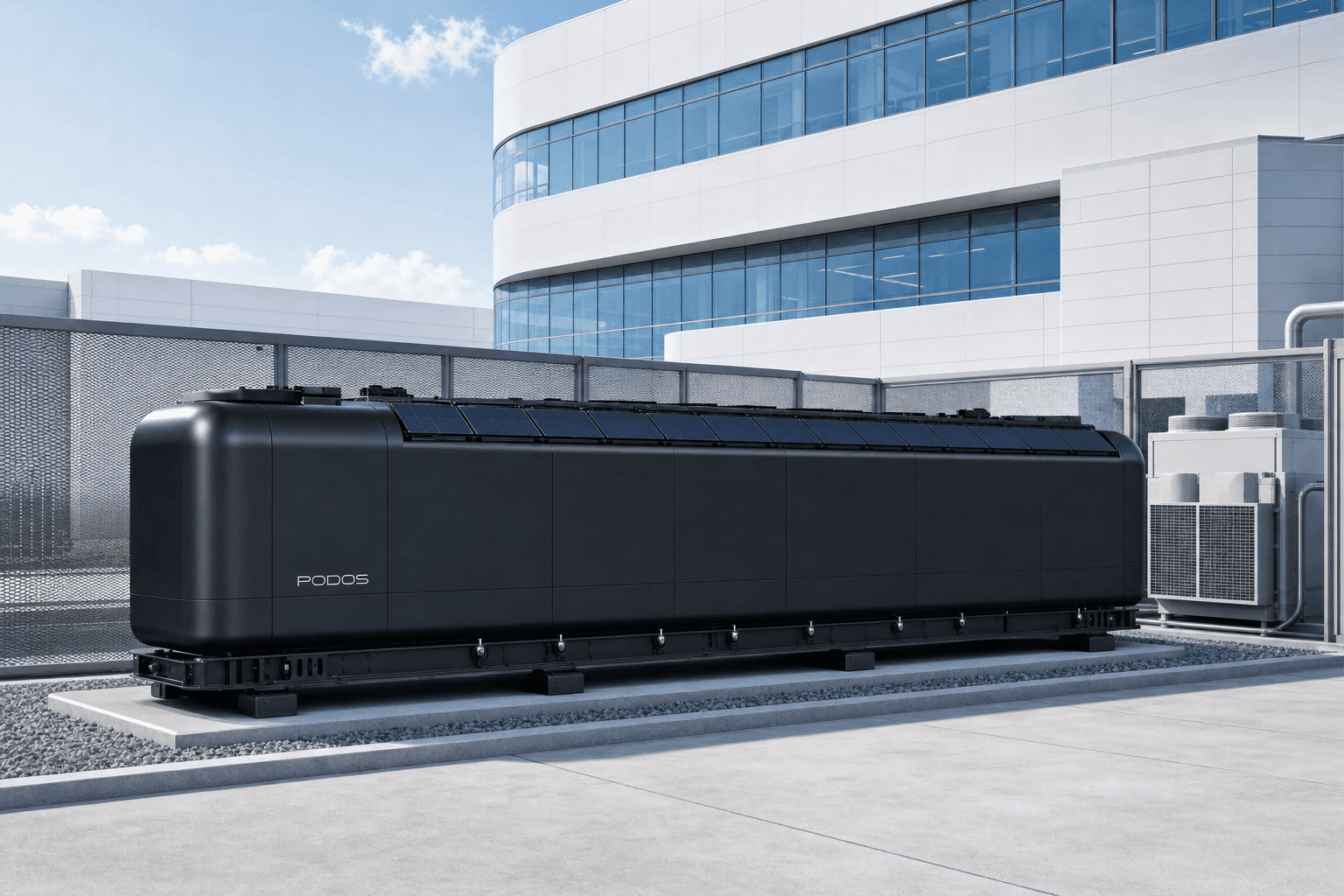
Every profile below therefore turns on the same three questions: what the workload actually is, which constraint binds first — power, cooling, space, data governance, or time — and whether a factory-built unit like the one described on the platform overview relieves that constraint or merely relocates it. These are workload profiles and design intent, not customer references: PODOS is an early-stage company, and no deployments, customers, or certifications are claimed on this page.
Vertical guides
Each guide takes one profile further: the workload in detail, the roles that must agree, the site requirements, and the cases where the answer is no.
Workload fit, buyer roles, site constraints, power, cooling, and network for enterprises deciding between cloud GPUs and dedicated on-site AI capacity.Enterprise AI infrastructure: when on-site GPUs make sense →
How grant cycles, campus power limits, and shared cluster demand decide whether a modular AI pod or a machine-room retrofit fits university research computing.University research computing: pod vs machine-room retrofit →
How health systems site AI compute on their own property: data residency, imaging and clinical inference workloads, hospital estate limits, and honest fit.Healthcare AI infrastructure: on-premises GPU compute →
How megawatt-scale edge AI infrastructure gets sited: latency-driven placement, power and connectivity limits, unattended operation, and when cloud wins.Edge AI infrastructure: placing compute near the data →
Router
A strong fit signal is a reason to read the matching profile; a weak fit signal is a reason to stop before spending engineering time.
| Code | Profile | Typical workload | Binding constraint | Strong fit signal | Weak fit signal |
|---|---|---|---|---|---|
| U-01 | Enterprise AI | Fine-tuning + steady inference | Rack density in existing rooms | High sustained GPU utilization | Spiky, experimental demand |
| U-02 | Universities & research | Shared training queues | Campus power and cooling | Funded multi-year cluster demand | HPC hall with headroom |
| U-03 | Manufacturing | Inspection + digital twins | Data gravity at plant sites | MV service on the estate | One-rack inference load |
| U-04 | Healthcare | Imaging + clinical language models | Data control, constrained estates | Institution-controlled land | Compliance path not yet scoped |
| U-05 | Government & secure | Sovereign or air-gapped AI | Authorization timelines | Defined-perimeter requirement | Data cleared for certified cloud |
| U-06 | Edge | Regional inference serving | Thin megawatt-class middle tier | Metro power near demand | Kilowatt-scale sites |
| U-07 | Supplemental capacity | GPU expansion of a full facility | Live-hall retrofit disruption | Campus land plus spare power | Stranded in-hall capacity |
| U-08 | Power producers | Compute at the generation source | Interconnection queues | Curtailed or queued megawatts | Intermittent supply, no storage |
Profiles
Each profile states both sides of the fit question — where a factory-built unit helps, and where it does not.
WorkloadSustained fine-tuning and internal inference on proprietary data — the pattern where reserved cloud GPU commitments run at high utilization month after month.Binding constraintCorporate server rooms were provisioned for single-digit-kW racks[3], and retrofitting one for direct-to-chip liquid cooling is often a larger project than the cluster itself.Where modular helpsA dedicated unit on company or leased industrial land gives the cluster a purpose-built envelope. Each PODOS Pod is designed as a standardized 1 MW building block, designed for 128 GPUs, so capacity planning stays arithmetic — units, not bespoke halls.Where it does notBursty experimentation and workloads that idle most of the week. If a megawatt cannot be kept busy, shared cloud remains the honest default.
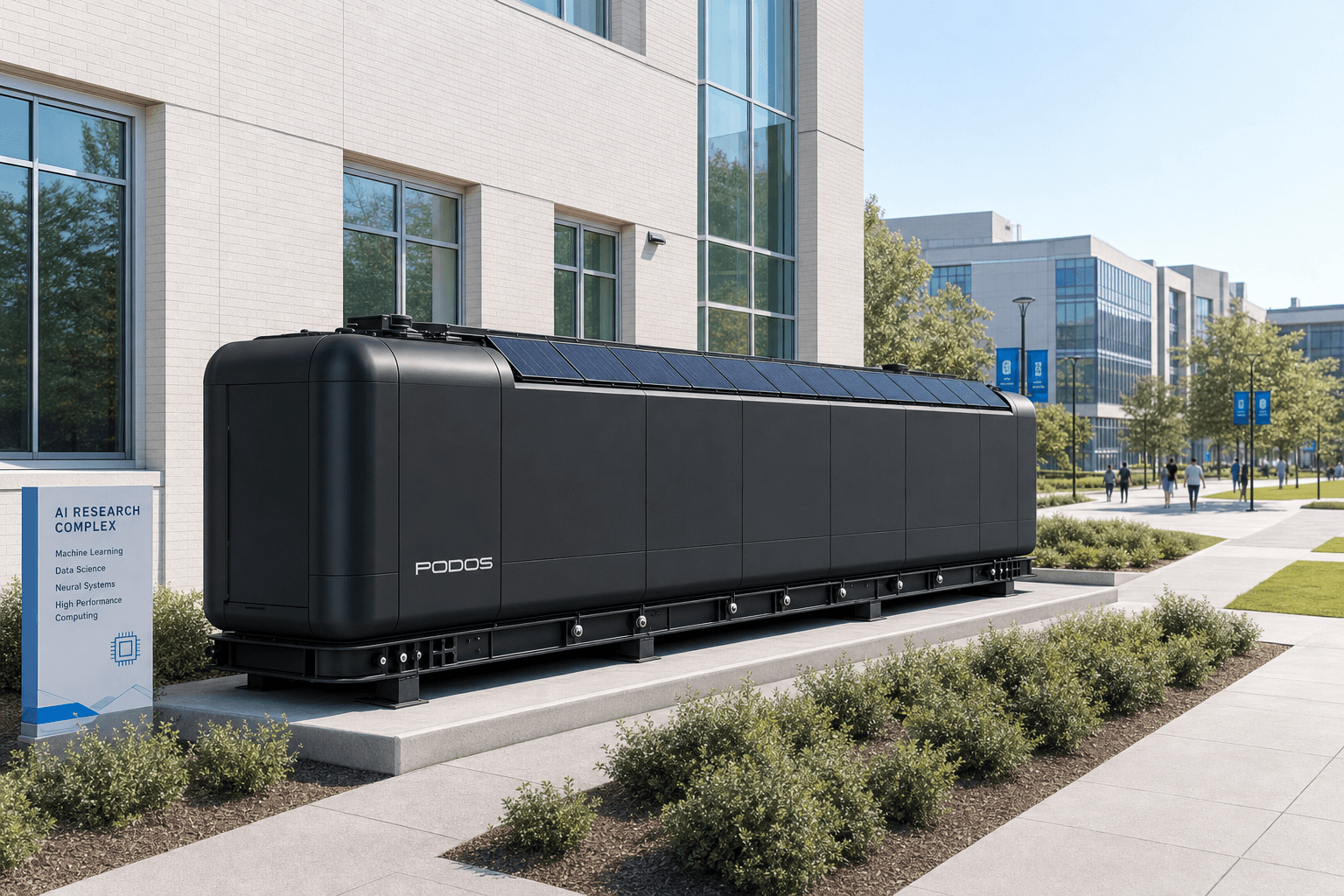
WorkloadMany principal investigators sharing one scheduler; long training queues; hardware funded in discrete grant awards.Binding constraintCampus machine rooms rarely hold spare megawatts or liquid-cooling loops, and new academic buildings move at capital-planning speed.Where modular helpsA self-contained unit sited near existing campus electrical infrastructure hands facilities teams a fixed, documented envelope — power in, heat out — instead of an open-ended construction program.Where it does notInstitutions whose HPC hall still has power and cooling headroom; expanding in place is usually cheaper. Funding rules that favor operating spend over capital purchases also point back to cloud credits.
WorkloadTraining and inference under sovereignty, air-gap, or controlled-access requirements that rule out shared cloud regions.Binding constraintProcurement and facility-authorization timelines dominate; a program can hold budget for compute yet wait years for an approved place to put it.Where modular helpsA physically bounded unit gives security teams a defined perimeter to assess — one enclosure, one power feed, documented ingress — rather than a shared hall.Where it does notModular construction shortens the building, not the authorization. PODOS claims no government accreditation, and programs whose data can lawfully run in certified cloud regions may find that path faster.
WorkloadRegional inference serving — models placed near users or data sources rather than in a distant region.Binding constraintThe middle tier is thin: device-level edge AI and hyperscale regions are both well served, while megawatt-class capacity in secondary metros is scarce.Where modular helpsA unit designed to be relocatable can occupy that middle tier where metro power exists — and move if demand does.Where it does notTrue edge sites measured in kilowatts — a closet rack, not a pod. Any latency benefit is workload-specific and should be measured before committing; no general number honestly applies. Full edge AI guide.
WorkloadAn operator whose existing halls are out of power or cooling headroom for GPU racks, with demand still arriving.Binding constraintRetrofitting a live hall for high-density liquid cooling disrupts tenants and takes floor space out of service.Where modular helpsAdded capacity beside the existing facility, on the same campus and network, while the main hall keeps running. PODOS targets a 90-day window from order to commissioning for a standard unit — the deployment process is documented separately.Where it does notHalls with stranded power and empty white space are often better served by a targeted retrofit — run that comparison before adding enclosures.
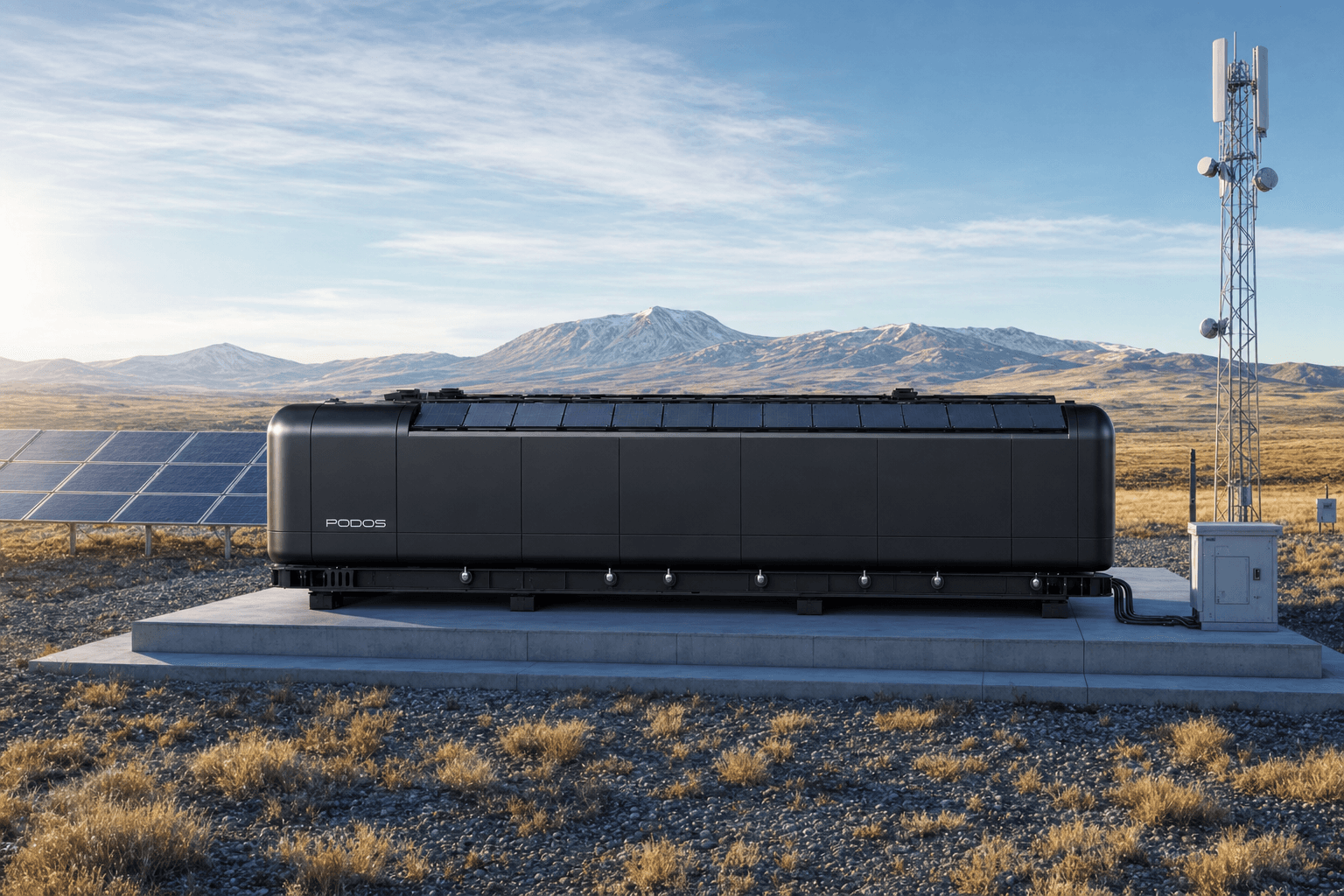
WorkloadTurning curtailed, queued, or under-contracted generation into a sellable compute product by colocating AI capacity at the source.Binding constraintInterconnection queues run years, and the IEA reports grid-connection bottlenecks tightening even as data-centre electricity use surged in 2025 [5].Where modular helpsCompute placed behind the meter consumes power where it is generated, and NREL has demonstrated data centers operating as flexible grid assets, including a 70 MW grid-interactive facility [4]. A unit-sized building block is intended to be matched to generation blocks rather than forcing a monolithic campus.Where it does notSites without a workable fiber path, or highly intermittent generation without storage. Compute economics depend on sustained utilization; a resource that runs a few hundred hours a year cannot carry a cluster.
U-03 · Manufacturing
Workload. Vision inspection, defect detection, digital-twin simulation, and process optimization — heavy inference near the line plus periodic retraining on plant telemetry.
Binding constraint. Data gravity. Plants generate more camera and sensor data than is economical to backhaul, and industrial estates have power but no data hall.
Where modular helps. Many industrial sites already take medium-voltage service — the class of input the pod's power architecture is designed around — so a unit can sit on the same estate as the machines it serves.
Where it does not. Batch analytics that tolerate a round trip to a cloud region, or a single line whose inference fits in one rack. A megawatt is the wrong granularity for a kilowatt problem.
U-04 · Healthcare
Workload. Imaging models, clinical documentation, and research on protected records — cases where governance teams want data on infrastructure the institution controls.
Binding constraint. Hospital estates are chronically short on space and power, and clinical buildings are the wrong place for a GPU cluster.
Where modular helps. A dedicated unit on institution-controlled property keeps training and inference inside the organization's own physical and network perimeter.
Where it does not. PODOS claims no healthcare compliance certification. Regulatory review, privacy assessment, and accreditation are the operator's work and run on their own clock; smaller inference loads may also fit hardware the institution already owns. The healthcare guide takes this further.
The question is never whether a factory-built unit is impressive. It is whether it relieves the binding constraint — or merely relocates it.
8
Profiles, both sides stated
HONEST LIMITS
Four disqualifiers recur across every vertical, and they are worth naming plainly.
Decision
If most checks pass, the next steps are the PODOS Pod unit page for what a unit is, the engineering section for how its systems work, and the AI infrastructure glossary for the vocabulary used across this site.
Bring the utilization curve, the binding constraint, and the power path. The configurator walks the same variables an engineering review would.