Cooling
Heat extraction from silicon to ambient. Direct-to-chip liquid cooling
ENG-00Engineering · Index
AI data-center engineering is the discipline of moving electricity into GPUs and moving heat back out — reliably, at densities conventional facilities were never designed to hold. Seven domains decide whether a megawatt of compute actually serves inference: cooling, power, compute density, the thermal envelope, networking, monitoring, and safety.
PUBLISHED LAST VERIFIED BY JOSEF ELIMELECHREVIEWED PODOS AI ENGINEERING
What this index covers
Data centers took about 1.5% of world electricity in 2024, and the IEA projects roughly double by 2030.
Uptime Institute finds industry-average PUE roughly flat for about six years while rack densities climbed into the 10–30 kW band.
A cooling shortfall becomes a density cap, a density cap strands power, and stranded power breaks the economics.
A factory-built unit answers each domain with a repeatable product surface rather than a fresh construction project.
The engineering library
Each domain below has a full explainer. Start with the one that constrains your site.
Heat extraction from silicon to ambient. Direct-to-chip liquid cooling
Medium-voltage service down to rack-level distribution. Data-center power architecture
kW and accelerators per rack, per square foot. High-density GPU infrastructure
The boundary between machine climate and weather. Thermal enclosure design
The east–west fabric between accelerators. Network architecture: fiber and leaf-spine
Telemetry, alerting, capacity forecasting. Monitoring and controls
Fire protection, energy storage, code compliance. Fire safety and physical security
What happens to the heat once a liquid loop has concentrated it into a recoverable stream. Data-center heat recovery
The pressure
The load is growing faster than the buildings. Data centers consumed about 1.5% of the world’s electricity in 2024, and the IEA projects that figure to roughly double by 2030, to about 945 TWh.[1] In the United States, data centers drew 4.4% of national electricity in 2023; Lawrence Berkeley National Laboratory projects between 6.7% and 12% by 2028.[2]At the same time, the industry’s average efficiency has stopped improving — Uptime Institute’s 2025 survey finds industry-average PUE roughly flat for about six years, even as typical rack densities climb into the 10–30 kW band.[3]
Conventional engineering answers this with bigger projects: more shell, more chillers, more substation. A factory-built approach answers it with a repeatable unit — solve each domain once, then manufacture the solution. The trade-offs between the two approaches are examined in modular AI data center vs traditional data center; the product architecture that results is described in the platform overview.
This index summarizes each domain, explains how the constraints change when the facility is a factory-built unit rather than a construction project, and links to the deep dive for every one.
Pre-mortem
Each domain has its own failure mode, and the failure modes compound: a cooling shortfall becomes a density cap, a density cap strands power, stranded power breaks the economics. The table reads as a pre-mortem — what goes wrong when a domain is under-engineered.
| Code | Domain | What it governs | Failure mode if under-engineered | Deep dive |
|---|---|---|---|---|
| ENG-01 | Cooling | Heat extraction from silicon to ambient | Thermal throttling — GPUs derate long before they fail | Read the explainer |
| ENG-02 | Power | Medium-voltage service down to rack-level distribution | Stranded capacity — a facility that cannot feed its own racks | Read the explainer |
| ENG-03 | Compute density | kW and accelerators per rack, per square foot | An overbuilt shell wrapped around underfilled racks | Read the explainer |
| ENG-04 | Thermal envelope | The boundary between machine climate and weather | Cooling plant sized for the worst hour of the worst day | Read the explainer |
| ENG-05 | Networking | The east–west fabric between accelerators | Idle GPUs waiting on the interconnect | Read the explainer |
| ENG-06 | Monitoring | Telemetry, alerting, capacity forecasting | Outages diagnosed after the fact instead of prevented | Read the explainer |
| ENG-07 | Safety | Fire protection, energy storage, code compliance | A unit that works but cannot be permitted | Read the explainer |
Domains 01–04
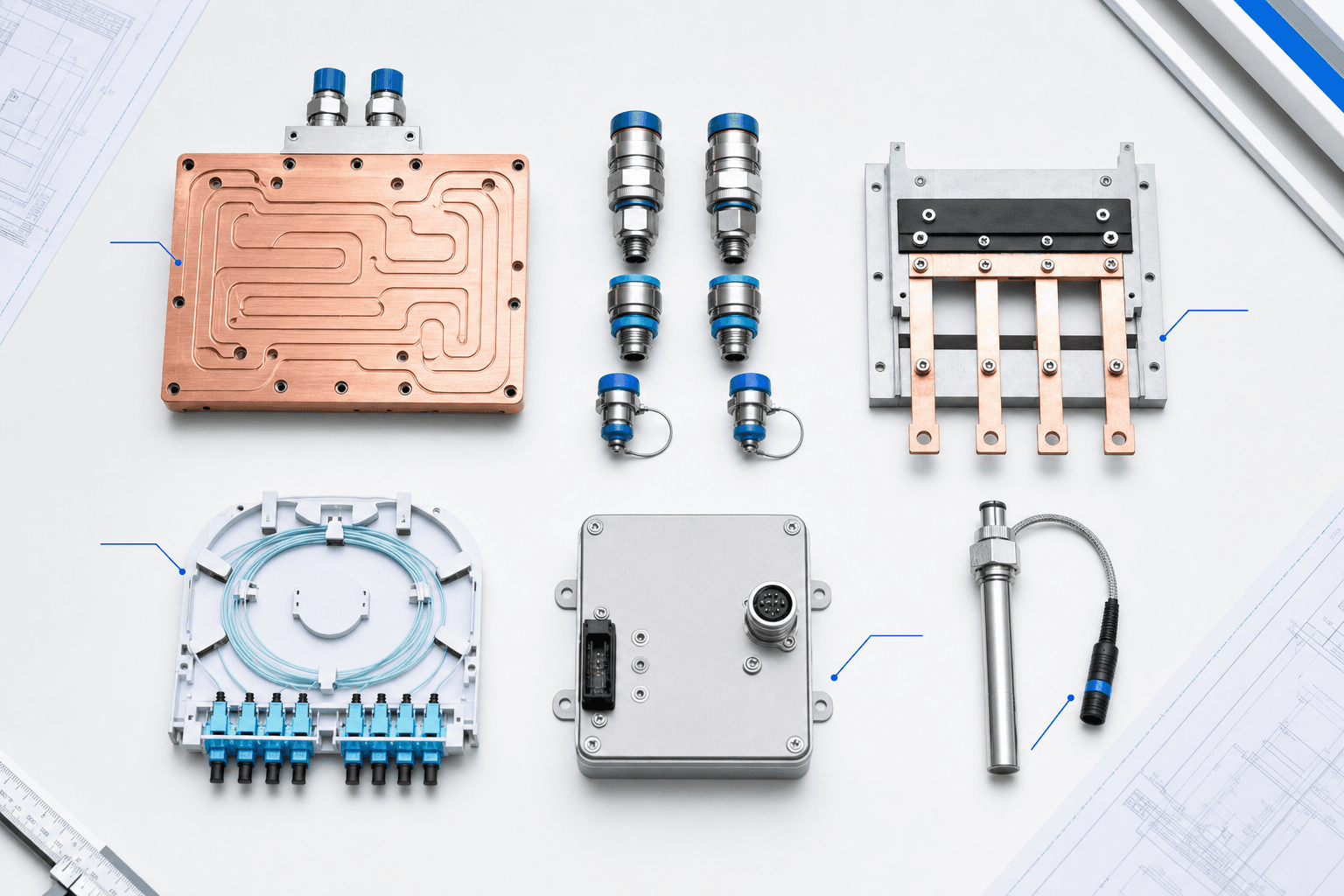
At AI densities, air stops being a workable transport medium for heat. ASHRAE TC 9.9 — the committee whose thermal guidelines define data-center environmental classes — has documented the shift toward liquid cooling in mainstream facilities as rack power rises.[4][5] The practical response is direct-to-chip liquid cooling: cold plates on the hottest silicon and a coolant loop in place of a room full of moving air, with the Open Compute Project now maintaining multi-vendor requirements for cold plates and coolant distribution units.[6]The PODOS Pod’s cooling is designed as a closed direct-to-chip loop, which also concentrates heat into a recoverable stream — NREL’s ESIF facility, for example, heats its offices with waste heat from liquid-cooled supercomputers and reports an annualized PUE near 1.04.[10] Both halves have their own explainer: direct-to-chip liquid cooling and data-center heat recovery.
A megawatt of IT load is an industrial electrical project. The chain runs from a medium-voltage utility feed through transformation, switchgear, distribution, and power conversion down to the rack — and every stage adds losses, footprint, and failure modes. Reliability engineering for that chain is a discipline of its own; the IEEE 3006 series covers reliability analysis for critical-facility power systems.[8] Field-built electrical rooms are engineered one project at a time. A factory-built unit integrates the same chain into a manufactured product, so the design is validated once and then repeated; the PODOS Pod is designed to accept a medium-voltage utility feed and carry distribution inside the unit. The full chain is walked stage by stage in data-center power architecture.
Density sets the requirements for cooling, power, envelope, and safety at once. Uptime Institute’s 2025 survey shows typical racks moving into the 10–30 kW band,[3]and accelerator vendors have already moved past it: NVIDIA’s GB200 NVL72 packages 72 GPUs and 36 CPUs into a single liquid-cooled rack that behaves as one NVLink domain.[7] Each PODOS Pod is designed for 128 GPUs inside its unit envelope — a design figure, not a measured deployment. The rack-level design problem is taken up in high-density GPU infrastructure. Signs a design has crossed the air-cooling threshold:
The envelope decides how much of the outside climate the cooling plant has to fight. ASHRAE’s environmental classes — A1–A4 for air-cooled equipment, an H1 class for high-density gear, and liquid-cooling classes named by facility water temperature — define the machine-side climate that must hold regardless of weather.[4] A conventional building maintains that climate with mass and mechanical plant, assembled on-site. A manufactured enclosure treats the envelope as a product surface: insulation and barriers engineered once, on a production line. The PODOS enclosure is designed as a fully insulated envelope, so cooling capacity is spent on silicon rather than on the weather — the subject of thermal enclosure design.
A cooling shortfall becomes a density cap, a density cap strands power, and stranded power breaks the economics.
945 TWh
IEA projection for data-center electricity in 2030
Domains 05–07
AI clusters live or die on east–west bandwidth — traffic between accelerators inside the cluster, not north–south traffic to the internet. Rack-scale designs make the point structurally: the GB200 NVL72 presents 72 GPUs as one NVLink domain because the interconnect is, in effect, the computer.[7] At unit scale the open engineering questions are topology, cabling economics, and how a unit designed as a standardized 1-MW block joins a larger fabric without re-architecting it — the questions taken up in AI data center network architecture: fiber and leaf-spine.
Half of the operators surveyed by Uptime Institute in 2025 reported an impactful outage within the previous three years.[3] Monitoring is the difference between a derate you catch and an outage you explain. In a factory-built unit, telemetry can be designed in — sensor points and alarms specified on the production line rather than commissioned ad hoc at each site. The open questions are which signals matter per subsystem, and what a fleet of standardized units makes possible that one-off facilities cannot: like-for-like comparison across every unit in service. Both are worked through in data-center monitoring and controls.
Data-center safety is governed by code. NFPA 75 covers fire protection for information-technology equipment spaces, and its 2024 edition moves stationary lithium-ion battery requirements out to NFPA 855 — so any unit that carries on-site energy storage inherits both standards.[9] Factory manufacture changes the compliance surface: detection, suppression, and egress can be engineered into a repeatable product instead of re-derived per project. It does not remove the local permitting authority, whose review remains site-specific. The standards landscape is mapped in modular data center fire safety and physical security.
In the product
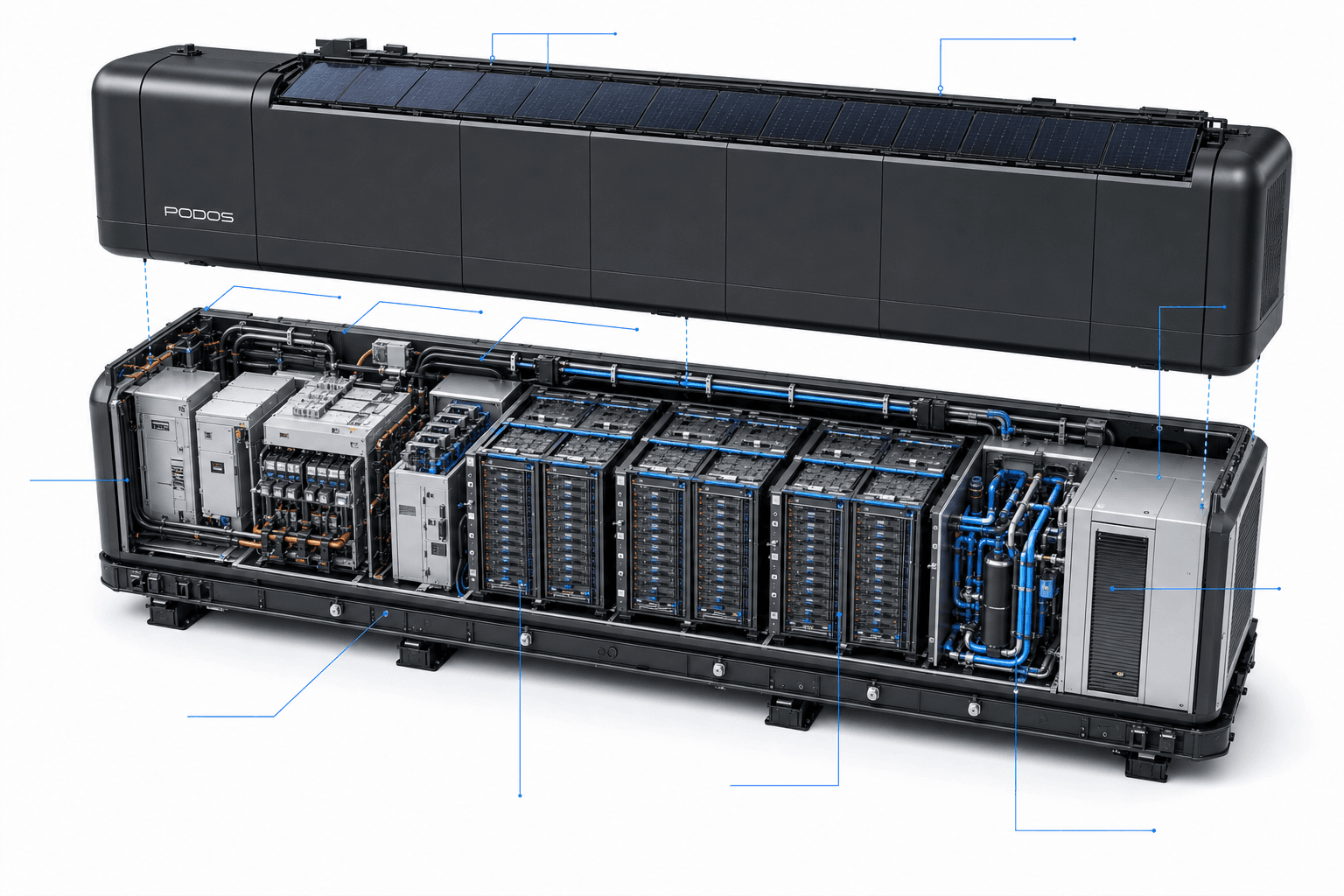
The positions above are embodied in one product. Each PODOS Pod is designed as a standardized 1-MW building block that integrates power, cooling, racks, and networking in a factory-built unit, with a 90-day target window from order to commissioning — a target, not a measured deployment record. The hardware is specified on the PODOS Pod product page; the order-to-commissioning process is described in deployment; terms used across this cluster are defined in the AI infrastructure glossary. The software layer above the hardware is covered under Syntropic, and the company’s investor page is at invest.
HONEST LIMITS
Send the load, the site, and the constraint that worries you most. Engineering will tell you which domain decides your build.